


 Settings
 Fast Delivery
 Free Shipping
 Incoterms
 Payment Types


 Marketplace Product


The 2026 Supply Chain: New Rules for Electronics OEMs
In 2026, the electronics supply chain stands at a unique and somewhat paradoxical crossroads. After years defined by extreme disruption, including pandemic shutdowns, port congestion, and component shortages, conditions are finally stabilizing. The electrical and electronics market grew from $3,844.55 billion in 2024 to $4,064.37 billion in 2025, a compound annual growth rate of 5.7%. Over the next three years, however, that growth rate will rise to 6.6% year over year (Figure 1).
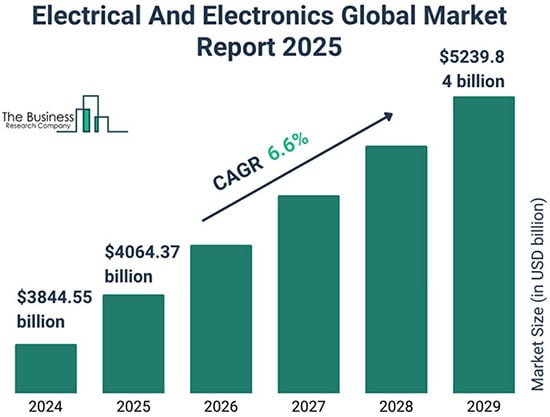 Figure 1: The electrical and electronics market grew from $3,844.55 billion in 2024 to $4,064.37 billion in 2025, a compound annual growth rate of 5.7%; that growth rate will rise to 6.6% year over year for the next three years. (Image source: The Business Research Company)
However, for original equipment manufacturers (OEMs) in the electronics industry, this stability should not be mistaken for predictability. The outlook for 2026 promises stable but uneven growth, with trade no longer the primary driver of GDP and domestic demand taking the wheel.1 While global demand signals are becoming clearer, structural risks remain deeply embedded in the system.2 From the integration of agentic artificial intelligence (AI) in procurement to the solidification of tariffs as a baseline operating cost rather than a temporary hurdle, the rules of engagement are changing.
For electronics OEMs, success in 2026 will not come from predicting the next crisis, but from designing supply chains that can absorb shocks and reallocate resources rapidly.3 As we begin the new year, it is essential to look at the critical trends shaping the landscape in 2026 and strategically prepare supply chain operations for a year of transformation.
Trend 1: The new normal of trade policy and regionalization
Supply chain leaders have hoped for a return to pre-tariff normalcy. In 2026, that hope must be replaced by a pragmatic acceptance that tariffs are the norm. The volatile tariff environment is leveling off into a period of cautious predictability, according to industry watchers. While the U.S. has secured bilateral trade deals with the EU, UK, and Japan, covering roughly 40% of imports, significant outliers remain.4
For electronics OEMs, this means that “landed cost” models must be permanently adjusted. We are moving away from tariffs as a temporary disruptor to tariffs as a fixed element of the operating context.
Trend 2: The AI revolution shifts from hype to operations
As we begin 2026, AI will evolve from a buzzword to an operational necessity. The focus is shifting from simply implementing processes to achieving performance outcomes.
A significant development in 2026 will be the rise of agentic AI.5 These are not just passive analysis tools; they are autonomous agents capable of performing tasks such as supplier evaluation, risk monitoring, and contract review. These agents can issue RFPs, evaluate responses, and even trigger onboarding processes with minimal intervention, allowing human procurement teams to focus on strategic relationships rather than administrative churn.
For the electronics sector, component obsolescence is a silent profit killer. A six-person engineering team can lose up to $400,000 annually managing obsolete components, and smartphone printed circuit board (pc board) redesigns can cost $46,000 per board spin.6 In 2026, OEMs will leverage predictive analytics to identify obsolescence risks early. AI-enabled platforms will allow engineering and procurement teams to align on bills of materials (BOMs) in real time, flagging lifecycle risks before a design is locked. This capability is critical because the winners in 2026 will be those who integrate this readily available data into their day-to-day decision-making.
Trend 3: Strategic inventory and sourcing resilience
The philosophy of inventory management has fundamentally changed. The lean, just-in-time models of the past have evolved into just-in-case strategies to address unforeseen changes. While establishing backup suppliers is standard practice, 2026 demands more than just redundancy; it requires reconfiguration capabilities as well. OEMs must build agile logistics frameworks that allow for rapid reallocation of materials. These frameworks must include multi-region sourcing intelligence and strategic inventory buffers for high-risk components. With an eye toward total value, OEMs are shifting from a responsive stance to one of disruption to actively maximize enterprise-wide value through customer-centricity and seamless integration among finance, operations, and procurement.7
Despite the available technology, accurate visibility remains elusive. According to a UPS survey, 90% of executives say visibility is vital, yet less than one-third have achieved it. Poor visibility correlates with 50% higher inventory carrying costs and 30% longer lead times. In 2026, solving this through tools like digital twins, which allow companies to run thousands of what-if scenarios without real-world risk, will be a key differentiator.8
Three ways to prepare for 2026
To navigate these trends, electronics OEMs must take proactive steps rather than adopt a wait-and-see attitude amid high-velocity change.
1: Leverage tax incentives for modernization
The opportunity: Beginning in 2026, favorable tax code changes will allow companies to accelerate tax benefits on qualified assets and property, rather than depreciating them over long horizons.9
The action: OEMs should use this window to modernize equipment and implement automation sooner than planned. Now is the time to invest in robotics and AI-powered systems that will define the next generation of U.S. manufacturing. Do not wait for multi-year ROI calculations; the tax advantages make immediate modernization financially viable.
2: Upskill the workforce for the AI era
The challenge: Technology will carry the weight of manufacturing booms, but it requires a skilled workforce. The most significant barrier to AI adoption is often not the technology, but the motivation and skillset of the team.10
The action: Move beyond repetitive tasks. Train your workforce to pilot AI tools rather than just being a passenger. Teams need a foundational understanding of how AI works and how to integrate it into Integrated Business Planning (IBP) workflows. The goal is a system in which employees focus on strategic decision-making while AI handles data crunching.
3: Adopt a "Total Value" mindset
The challenge: Traditional metrics such as cost per unit are insufficient to capture the complexity of 2026.
The action: Shift the focus to considering Total Value, which unites customer experience and operational performance.11 Implement new metrics such as:
• Modal agility score: The ability to switch transport modes based on disruption
• Automation rate: Tracking the percentage of transactional processes handled by AI
• Resilience metrics: Measuring recovery time after disruptions and revenue growth derived from improved customer experiences
A divergence between stable demand and volatile execution will define the electronics supply chain of 2026. While the macroeconomic picture suggests stable growth, the operational reality is complex and marked by intense AI-driven technological disruption. The organizations that thrive will be those that stop viewing these elements as separate challenges and start viewing them as an interconnected ecosystem.
References
1, 4, 8: https://www.youtube.com/watch?v=xD1qtWyXDjY
3, 9: https://www.oliverwight-americas.com/blog/2026-supply-chain-predictions/
5, 11: https://kpmg.com/xx/en/our-insights/operations/supply-chain-trends-2026.html
6: https://www.calcuquote.com/blog/the-future-of-electronics-supply-chain-in-2026-beyond
About this author

Hailey Lynne McKeefry is a freelance writer on the subject of supply chains, particularly in the context of the electronics components industry. Formerly editor-in-chief of EBN, “The Premier Online Community for Supply Chain Professionals”, Hailey has held various editorial contribution and leadership roles throughout her career, but as a Deacon she balances her work with her other passion: being a Chaplain and Bereavement Counsellor.

Have questions or comments? Continue the conversation on TechForum, DigiKey's online community and technical resource.
Visit TechForum




