






 Settings
 Fast Delivery
 Free Shipping
 Incoterms
 Payment Types


 Marketplace Product
Intro to Embedded Rust Part 4: Ownership and Borrowing | DigiKey
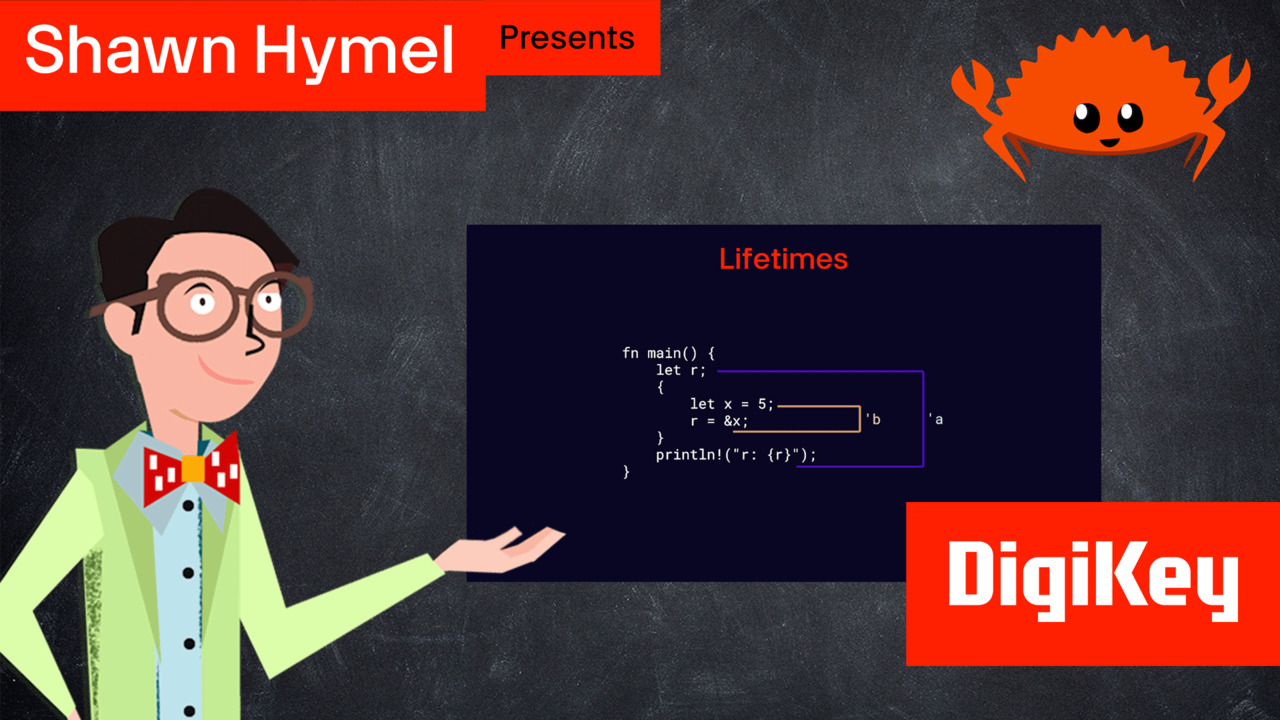
Rust's ownership and borrowing system can be confusing at first. In this video, we break down the seven fundamental rules that govern how Rust manages memory safely without a garbage collector or runtime overhead. To keep it applicable to embedded systems, we use a stack-based example (rather than relying on the heap examples found in the Rust Book). You'll learn how ownership transfers work, when values are dropped from memory, and how references provide safe access to data without the memory bugs that plague C and C++ programs. No hardware required for this episode: just your computer and the Rust compiler to explore these concepts through hands-on code examples. The written guide for this episode can be found here: https://www.digikey.com/en/maker/tutorials/2026/intro-to-embedded-rust-part-4-ownership-and-borrowing The GitHub repository containing the Docker image and example code for this series can be found here: https://github.com/ShawnHymel/introduction-to-embedded-rust This tutorial provides an in-depth exploration of Rust's memory management rules, covering each principle with clear examples and explanations. We start with basic ownership: how each value has exactly one owner and what happens when ownership is transferred (moved) between variables. You'll understand the difference between types that implement the Copy trait (like primitive integers and arrays) versus types that use move semantics. We explore scoping rules and how Rust automatically deallocates memory when owners go out of scope, eliminating memory leaks without manual cleanup. We then dive into borrowing and references, explaining the crucial rule that you can have either multiple immutable references or one mutable reference at a time. We also look at why references must always be valid, preventing dangling pointer bugs that cause crashes and security vulnerabilities in other languages. We demonstrate partial moves with compound types like tuples and structs, showing what happens when you move ownership of only part of a value. We conclude with slice operations, including how to create multiple mutable slices to non-overlapping array regions using split_at_mut() (a useful pattern for working with buffers in embedded systems). Unlike typical Rust tutorials that rely heavily on heap-allocated types (like String and Vec), our examples use stack-only data structures that mirror real embedded development constraints, making this tutorial especially relevant for bare-metal programming. These ownership and borrowing rules are what make Rust unique among systems programming languages, offering the performance of C with memory safety guarantees typically found only in garbage-collected languages.


Part List
| Image | Manufacturer Part Number | Description | Available Quantity | Price | View Details | |
|---|---|---|---|---|---|---|
 |  | SC1631 | RASPBERRY PI PICO 2 RP2350 | 25971 - Immediate | $4.30 | View Details |
|  | SC1632 | RASPBERRY PI PICO 2 H RP2350 | 2754 - Immediate | $5.16 | View Details |
|  | SC1633 | RASPBERRY PI PICO 2 W RP2350 | 5965 - Immediate | $6.02 | View Details |
|  | SC1634 | RASPBERRY PI PICO 2 WH RP2350 | 2210 - Immediate | $6.88 | View Details |
|  | CF14JT220R | RES 220 OHM 5% 1/4W AXIAL | 109274 - Immediate 30000 - Factory Stock | $0.09 | View Details |
|  | LTL-4224 | LED RED CLEAR T-1 3/4 T/H | 72310 - Immediate | $0.12 | View Details |
|  | 13314 | TMP102 DIGITAL TEMP SENSOR BOARD | 248 - Immediate | $5.12 | View Details |
|  | DH-20M50055 | USB AM TO USB MICRO, USB 2.0 - 1 | 10945 - Immediate | $1.33 | View Details |
|  | 1957 | JUMPER WIRE M TO M 6" 28AWG | 3608 - Immediate | $1.68 | View Details |
|  | FIT0096 | BREADBRD TERM STRIP 3.20X2.00" | 3452 - Immediate | $2.50 | View Details |
|  | 1825910-6 | SWITCH TACTILE SPST-NO 0.05A 24V | 42577 - Immediate | $0.11 | View Details |






 Lithuania